


The echo of a long-gone era, steeped in mystery, enchantment, and intriguing rituals, is encapsulated in the beguiling pages of The Shams al-Ma’arif. This enchanting text written in the twelfth century transports us back to a world humming with the latent power of ancient Arabian magic.
Translated as 'The Book of Sun of Gnosis', this magical tome, written by Ahmad al-Buni, stands as one of the most influential books in the canon of Islamic esotericism. Its tantalisingly cryptic spells, enchantments, and incantations exemplify the profound understanding the Arab world had of astronomy, numerology, and talismanic magic.

The Shams al-Ma’arif, pivotal in revealing the complex, enchanting world of Arabian mysticism, is steeped in symbology. Its captivating pages are filled with magical squares, complex anagrams, and charts revealing the mysteries of the celestial bodies. But to understand the true essence of this ancient book's magic, we must delve into its historical context.
Situated within a time of vibrant intellectual expansion, during the Islamic Golden Age, the book reflects the world's burgeoning interest in mysticism, philosophy, and the sciences. Al-Buni, its author, was renowned for his deep understanding of the Arab occult arts, making this text a pinnacle of his esoteric knowledge.

The Shams al-Ma’arif's influence extends beyond its era, as its enduring legacy remains prevalent even today among practitioners of the occult arts. It has notably influenced modern perceptions of the fascinating world of Arabian magic and has been referenced by occult scholars from various traditions across centuries.
Yet, the book's reputation isn't exempt from controversy. While some perceive the book as a priceless repository of ancient magical wisdom, others view it as a potentially dangerous tool of dark enchantments and curses. It's worth noting that even the most seasoned readers of esoteric literature approach this book with caution due to its potent energy.

Despite the veils of obscurity shrouding the Shams al-Ma’arif, it holds invaluable insights into the magical traditions of the Arab world, particularly from the aspect of numerology and astral magic. The rich depictions of incantations and talismans offer an enticing glimpse into the mysticism that pervaded the ancient Arab society.
The spellbinding composition found within this book isn't simply enchanting folklore or symbolic gibberish. Instead, each cryptic sentence, magical square, and celestial chart constitutes a complex system of magic that dictated the course of lives, battles, and even empires of the era.
Beyond its magic, the Shams al-Ma’arif also serves as a historical document, a testament to a period that held a profound belief in the unseen forces of the universe. It embodies an Arabia yearning for knowledge, connection, and understanding of mysteries beyond the perceptible realm.
In many ways, it can be said that the underlying essence of this book is a quest for knowledge—not merely of the esoteric and mystical but also of the unknowable universe at large. The endeavour for understanding, the hunger for grasping the secrets of the cosmos and manipulating them to serve human ends—such is the spirit echoed in the timeless pages of the Shams al-Ma’arif.
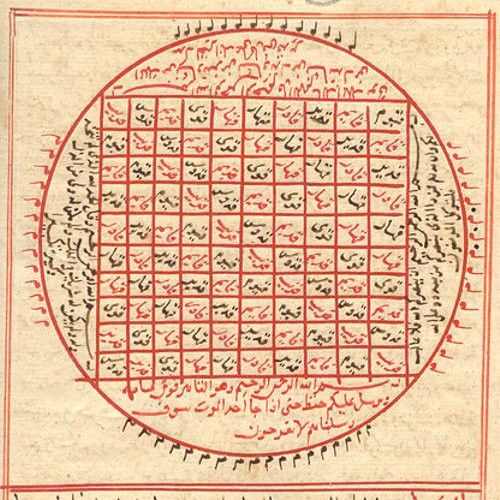
In conclusion, The Shams al-Ma’arif, with its cryptic spells, celestial charts, and intricate talismans, stands as not just a testament to an ancient, magical past, but as an ever-enduring beacon of fascination.
It's profound allure lies in the aurora of mystery that encapsulates it, an enigma that persists in our time as much as it did in its own, casting its mystical spell on those daring enough to peer into its secrets.
The echoes of this ancient book of Arabian magic can still be heard echoing, whispering, calling to those with an ear for the sacred, the mystical, and the unknown.
Shams al-Ma'arif - The Most Dangerous Book in the World?
Shams al-Ma'arif EXPOSED: Dark Magic, Jinn & Islamic Occult Secrets







Comments
0 comment