


The stunt of journeying across the world
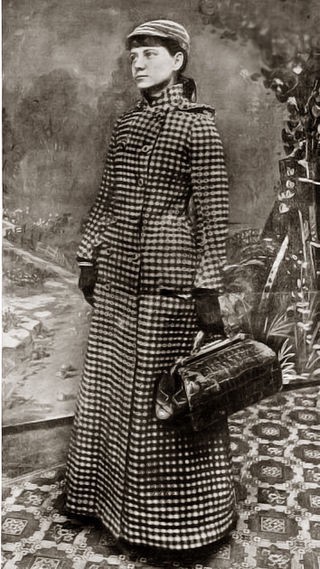 A publicity photograph taken by the New York World newspaper to promote Bly’s around-the-world voyage — Public Domain
Nellie Bly would later write about her journey in a book titled Around the World in Seventy-Two Days, inspired by Verne’s book.
The journey itself was suggested in 1888 when Bly suggested to her editor in the New York World, run by Joseph Pullitzer, that she hoped to take a journey around the world. She liked Verne’s book and wanted to turn the book into fact. But Pullitzer regretted sending her on the journey because he thought it was impossible, telling her:
“No one but a man can do this.”
Bly decided to pose as a maid struggling with a meager salary, and she knew that newspapers wanted a story that included truth, entertainment, and justice.
She went on a journey where she boarded the Augusta Victoria, a steamer of the Hamburg America Line. Her goal was to go almost 25,000 miles around the world with the goal of finishing in 75 days. All she bought was a dress, an overcoat, changes of underwear, and a small travel bag of her toiletry essentials. Most of her money in the form of English banknotes were carried around her neck.
The trip did not start off well. She was violently seasick as a first-time traveler and the sight of food made her nauseated. One day, she would sleep for 22 hours to regain her energy for the rest of the trip.
At the time, she had some competition. Elizabeth Bisland from the Cosmopolitan would try to beat both Bly and Phileas Fogg, trying to travel the opposite direction around the world. Bly would learn that Bisland reached Hong Kong, but she would not be phased.
“I would not race,” she said. “If someone else wants to do the trip in less time, that is their concern.”
Along the way, however, is where I find the most interesting details of Bly’s journey. She would have not that much empathy for foreigners she discovered across the world, including calling Chinese beggars “so repulsive that instead of appealing to one’s sympathy they only succeed in arousing one’s disgust” and Mexican men as “hungry but well-bred dogs.”
“Bly was a crusader, but she could also be remarkably callous, a failing that’s particularly glaring — and galling — in the context of tourism. There is a sense in which Bly is both the grandmother of the genre and its principal cautionary tale,” Gregory said.
When Bly arrived in Southampton in England, she received notice that Jules Verne gave her an invitation to visit him at his home in Amiens, France. To avoid missing her connection to London, she didn’t sleep for two days and met Vernes and his wife. They communicated via translator, and Bly would learn that Verne’s story was inspired by a news article, which added fuel to Bly’s fire.








Comments
0 comment